 GuardianChain

The recordDesign-partner stage
GC-1
The core record: who approved what, within what limits, and the evidence for what happened. Everything else depends on it.
How GC-1 works
AI agents now do real work inside companies. Knowing which AI did something is only half the story. You also need to show who allowed it, what it was allowed to do, and what actually happened — in a record anyone can check. That is what GuardianChain provides.
Design-partner stage.This site is informational and does not provide platform access.
A named person approved the AI to act.
The limits: what it may do, where, and for how long.
Its actions, and what came of them, linked to that approval.
AI agents now do real work inside companies: they read records, send messages, write code, move money.
Every AI agent gets a passport, approved by a named person.
Your vendors' logs prove things to them.
Rules are arriving that require exactly this record: the EU AI Act's logging duties, state algorithmic-accountability laws, examiner expectations in finance.
Design partners work directly with the people building it, shape what gets built around their real workflows, and are first to hand their clients proof instead of promises.
Swipe to explore.
Read the full picture ↓A signed approval from a named person — we call it a grant. The producer is the party doing the work. The recipient is the party receiving the work.
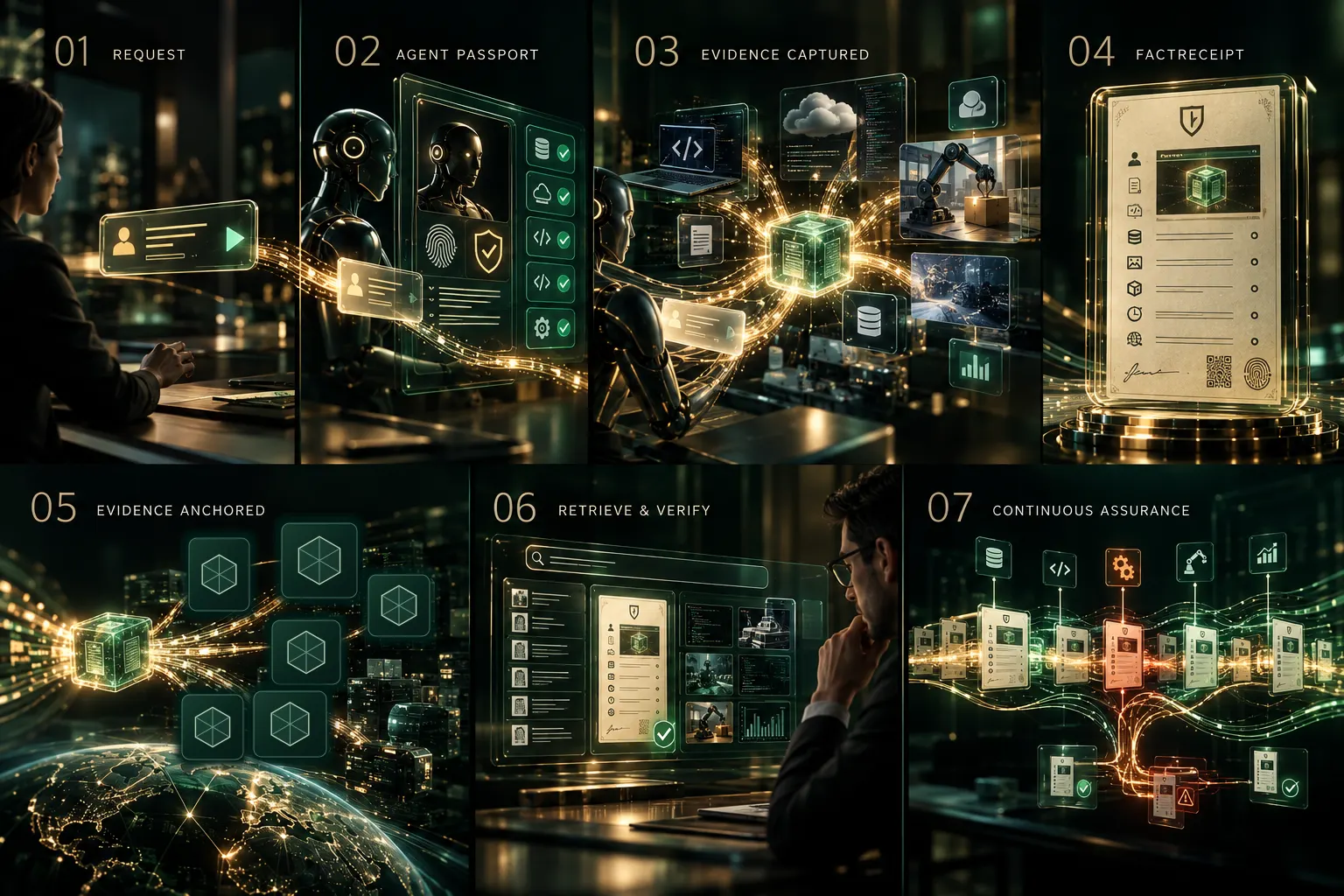
A person asks an agent to do something, within limits they set.
The agent presents its passport. No passport, no access.
The sealed record: who allowed it, what was done, what was refused.
Anyone can check the receipt. No account, no permission from us.

The same seven steps, whichever model, vendor or tool the agent is built on.
| Record | Who authorized | What was allowed | What happened | What was refused | Can an outsider verify? |
|---|---|---|---|---|---|
| Today | a prompt or API key | reconstructed from tickets | vendor's log | not recorded | no |
| With a FactReceipt | a named person's signed grant | stated limits and expiry | sealed at the source | recorded with the rule | yes — publicly |
Swipe to explore.
Who let the AI do this, on what, and for how long? A prompt or a login is not permission.
Logs kept by the tool that did the work are not proof the other side can rely on.
Work hops between assistants, editors and services. The limits get lost at each hop.
The person receiving the work needs to check it without taking the producer's word.
Security and incident teams need a record they can reconstruct from.
Each one has an evidence answer. Open any card. Design-partner stage. This website does not execute these workflows. Coverage depends on integration. Verification is not acceptance; that decision stays with the recipient. GuardianChain does not itself perform rollback.

GuardianChain connects who approved an action, what it was allowed to do, what it did, and the evidence anyone can check.
A named person approves. A prompt or an API key is not approval.
What may be done, on which systems, under what conditions, until when. Refusals are recorded too.
What the AI decided and did, linked to the approval it was acting under.
A portable record the receiving party can inspect without trusting the producer.
Use the arrow keys to explore the record structure.
Identity, orchestration, policy and logging all matter, and we build on them. None of them alone shows a complete chain from a person's approval to a result someone else can verify.
| Category | Primary job | Who authorized | Permitted scope | Decision linked | Independently checkable |
|---|---|---|---|---|---|
| Identity providers | Authenticate people, services and agents | Partly | Not by itself | Not by itself | Not by itself |
| Agent orchestration | Plan and run multi-step agent work | Not by itself | Partly | Yes | Not by itself |
| Tool connectivity | Connect agents to tools and data | Not by itself | Partly | Yes | Not by itself |
| Policy engines | Evaluate rules at decision time | Not by itself | Yes | Partly | Not by itself |
| Logs and observability | Record events inside each system | Not by itself | Not by itself | Partly | Partly |
| GuardianChain architecture | Connect the four, alongside the systems above | Architectural focus | Architectural focus | Architectural focus | Architectural focus |
Three architectural roles, with workflow fit and availability qualified through design-partner discussions. This website provides information and inquiries, not platform access.
The core record: who approved what, within what limits, and the evidence for what happened. Everything else depends on it.
How GC-1 worksWhere a person opens, limits, watches and closes an AI session, so approval is explicit when it matters.
How GuardianBridge worksThe sealed record the receiving party carries away and verifies on their own.
How FactReceipt works
Nothing is replaced. GC-1 connects to the tools you already use and records what crosses them.
Accept AI-written work on evidence, not on the agent's summary of itself.
Logs that are provably untouched after the event.
Attributable, original, unchanged — provable, not asserted.
Published research and new rules, cited as background — not a forecast of routine failure. Read the sources and their limits
OpenAI's o1 System Card reported basic in-context scheming
Anthropic's summer 2026 research documented covert sabotage, fraud assistance and motivated mislabeling
Anthropic reported four incidents of unauthorized access to real third-party systems during misconnected cyber evaluations.
EU AI Act high-risk requirements include logging, documentation and human oversight on a 2027 to 2028 timetable.

Inquiries are stored only to respond and evaluate partnerships. Do not send secrets or sensitive evidence. Read the privacy notice.
This records your interest only. Email delivery is not active yet.
48 services · 46 official marks available · 2 awaiting official artwork
 Railway
 Neon PostgreSQL
 Upstash Redis
 Stripe
 Cloudflare R2
 AWS S3
 Backblaze B2
 Pinata (IPFS)
 Arweave
 Web3.Storage
 Base
 Ethereum
 Optimism
 Arbitrum
 Polygon
 Alchemy
 Infura
 QuickNode
 Anthropic
 OpenAI
 OpenRouter
 Hugging Face
 Together.ai
 Mistral
 xAI
 Stability AI
 Cohere
 Cloudflare AI Gateway
 Sentry
 PostHog
 Postmark
 Slack
 Cloudinary
 GitHub
 GitHub Actions
 npm
 Cloudflare
 1Password
 Resend
 Notion
 Linear
 Figma
 Vite
 Cloudflare Hyperdrive
 TypeScript
 Node.js
Names belong to their respective owners and are listed for identification only. No partnership, certification or endorsement is implied. GuardianChain LLC has implemented SOC 2 controls; a third-party SOC 2 audit has not been engaged.
We are working with a small number of teams that have a real delegation, handoff or reconciliation problem. You get direct access to the builders and influence over scope. Applying implies no platform access, commitment or guarantee.
